What Is a Cabaret Show? Cancan, Burlesque and Paris Traditions
See prices From 142 EUR · Free cancellation available
Contents
A cabaret show is a live theatrical revue built from a sequence of staged acts, typically mixing dance, music, costume design and sometimes comedy or burlesque, performed in a dedicated venue rather than a general nightclub or concert hall. Here is what I would actually tell you before you book one: the word covers a genuinely wide range of formats, and the Paris venue you choose decides far more about your night than the generic label “cabaret” does.
I want to untangle the genre itself here, cancan, revue and burlesque as distinct traditions, before you pick a specific show, because I think a lot of confusion about Paris cabarets comes from treating the word as one single thing. Once you know what you are actually choosing between, my best cabaret shows in Paris comparison is the page I would read next to rank the real venues against each other.
Where Does the Word “Cabaret” Come From?
The term originally referred to a type of informal venue, a wine cellar or small club, that hosted music, poetry and performance in a casual setting, well before it came to mean the large-scale revue shows most travelers picture today. Paris played a central role in that evolution starting in the late 19th century, with venues built around variety entertainment for a paying public audience.
I would not get too hung up on the word’s exact origin story, though. What actually matters for planning a trip is what a modern cabaret show includes today, which, at the famous Paris venues, is a world away from a quiet neighborhood club night.
Check prices & dates
Ready to visit?
Book your tickets in advance: popular time slots sell out.
What Is the Cancan, and Why Is It Tied to Cabaret?
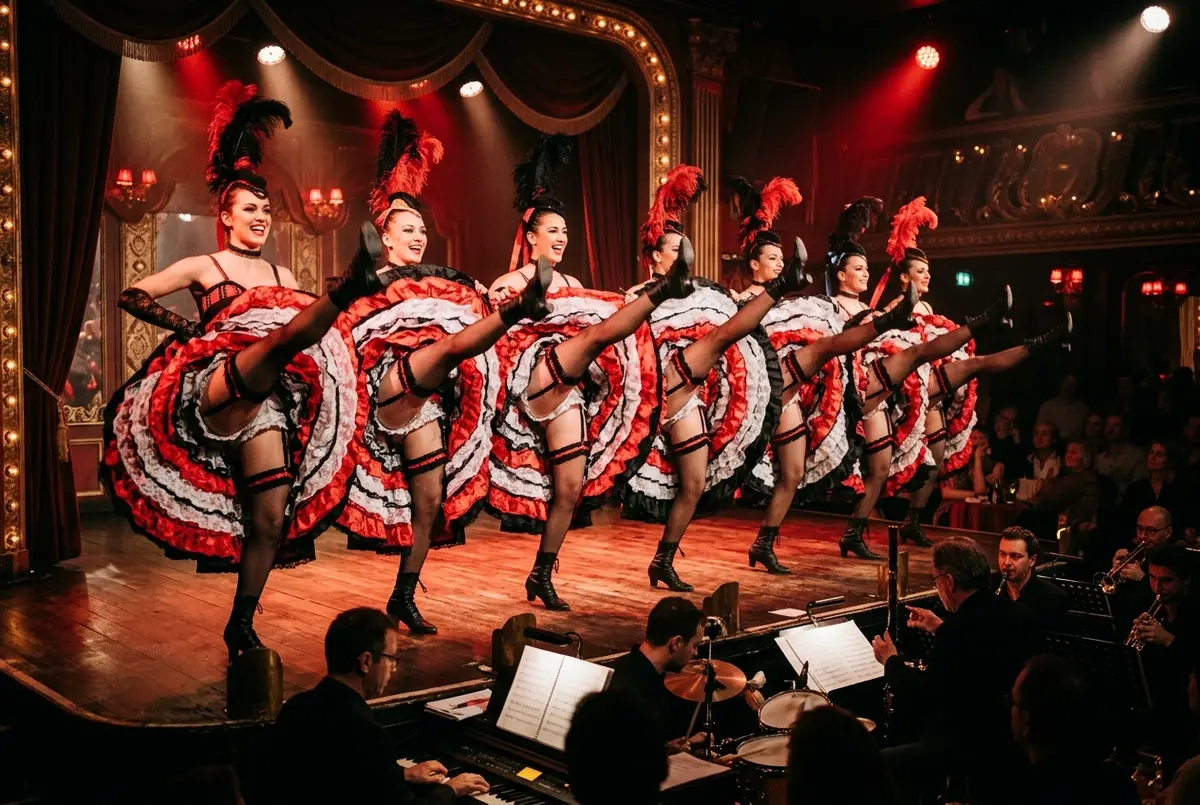
The cancan is a high-energy, high-kicking dance performed by a line of dancers in layered, ruffled skirts, historically considered provocative and now one of the signature closing numbers at Paris’s most famous cabaret shows. It became associated with the genre specifically through venues like the Moulin Rouge, which built its reputation partly on perfecting this exact number as its grand finale.
If you only know one thing about Paris cabaret before you go, I would make it this: the cancan finale is the moment most people are actually picturing when they imagine “a Paris cabaret show.” It is worth knowing that going in, since not every cabaret venue centers its show around it the same way.
What Is a Revue-Style Cabaret Show?
A revue is a cabaret format built as a sequence of themed acts, often loosely connected rather than telling one continuous story, each with its own costumes, music and choreography. This is the format behind the Moulin Rouge’s Feerie show, structured as a series of distinct numbers building toward the cancan finale, performed by a large resident cast with a live orchestra.
I think of revue-style cabaret as the most “spectacle-driven” version of the genre, built to impress on scale and production value as much as any single performance. My honest take: if you want the biggest, most crowd-pleasing version of a cabaret night, a revue-style show is what you are actually looking for, and the Moulin Rouge is the clearest example of it in Paris today.
What Is Burlesque-Style Cabaret, and How Is It Different?
Burlesque-style cabaret leans more on artistic, often nude or semi-nude choreography built around lighting, body paint and projection design rather than big costumes, live orchestras or a cancan finale. It tends to feel more intimate and more abstract than a revue, performed in smaller rooms built for a closer connection between performer and audience.
I would describe burlesque-style cabaret as the more adult, more artistic cousin of the revue format, not a lesser or smaller version of the same thing. The Crazy Horse Paris is the clearest example of this style done at a famous, long-running venue, and it suits a genuinely different kind of evening than a big revue show does.
Is a Cabaret Show the Same as a Nightclub?
No, and I think this distinction matters more than people expect going in. A nightclub is primarily about dancing and socializing with a DJ or live band providing a backdrop, while a cabaret show is a seated, scheduled theatrical performance with a defined start and end, built around watching a production rather than being the center of it yourself.
I would not go into a cabaret evening expecting to dance along or move between tables the way you might at a club. You are there to watch a performance, usually from an assigned seat or table, which changes the whole shape of the evening compared with a typical night out.
Is a Cabaret Show the Same as Live Theater?
Closer, but still distinct. A cabaret show shares theater’s structure, a fixed venue, scheduled performances, a paying seated audience, but it typically skips a single continuous plot in favor of a sequence of standalone acts, and it often includes dining as part of the ticket in a way conventional theater rarely does.
I would think of cabaret as sitting somewhere between a variety show and a themed dinner-and-performance evening. My honest framing: if you love theater but want something lighter and less narrative-driven for one night of your trip, cabaret is a natural fit.
Do You Need to Speak French to Enjoy a Cabaret Show?
No, and this is one of the more reassuring things I can tell first-time visitors. The big Paris revue shows lean heavily on music, dance and visual spectacle rather than spoken dialogue, which makes them genuinely accessible regardless of which language you speak. Any narration tends to be minimal and secondary to the performance itself.
I would not let a language concern talk you out of booking one of these shows. The visual and musical elements carry the night, and I think that is actually part of why these venues draw such an international audience night after night.
Which Paris Cabaret Shows Use Which Style?
The Moulin Rouge is the clearest revue-style example, built around spectacle, costumes and the cancan finale. The Crazy Horse represents the burlesque-style end of the spectrum, built on artistic choreography and lighting instead. The Lido and Paradis Latin each run their own distinct formats that blend elements of both traditions in different proportions.
If this is your first Paris cabaret and you are not sure which style suits you, I would default to the revue format, specifically the Moulin Rouge, since it is the more broadly crowd-pleasing of the two main styles and the one I would recommend to almost any mixed group. I would save a burlesque-style show for a second cabaret visit, once you have a clearer sense of what you actually enjoyed about the first one.
A cabaret show is not one single thing, it is a genre with real variation inside it, and I think knowing that before you book makes the difference between an evening that matches your expectations and one that does not. For most first-time visitors, I would point toward a revue-style show for the broadest, most reliably enjoyable introduction to the format, and consider a burlesque-style evening only once you know that artistic, more adult tone is genuinely what you want.
What exactly is a cabaret show?
A live theatrical revue combining dance, music, costume and sometimes burlesque or comedy, performed in a dedicated venue rather than a nightclub or concert hall.
Is the cancan part of every cabaret show?
No. It is a signature number at certain revue-style venues, most famously the Moulin Rouge, but not every cabaret show builds around it.
Is a cabaret show appropriate for kids?
It depends on the specific venue. Revue-style shows tend to be more broadly appropriate, while burlesque-style venues are typically adults-only by design.
Do I need to understand French to enjoy a Paris cabaret show?
No. These shows rely mainly on music, dance and visual spectacle rather than spoken dialogue, which makes them accessible regardless of language.
What is the difference between burlesque and revue cabaret?
Revue leans on spectacle, costumes and scale, often with a live orchestra and a cancan finale. Burlesque leans on artistic, more intimate choreography built around lighting and shadow rather than big production numbers.