Montmartre tourist attractions cluster tightly enough that you can genuinely cover most of the essentials on foot in a single half day. Sacre-Coeur anchors the list, but the neighborhood has real depth beyond the basilica once you know where to look.
I am going to rank the top sights worth your time, give one honest line on each, and link to a deeper page where one already exists for anything that deserves more than a paragraph. I will also cover the Tour de France connection, since it is a genuinely fun bit of trivia that surprises a lot of first-time visitors.
What Are the Top Montmartre Tourist Attractions?
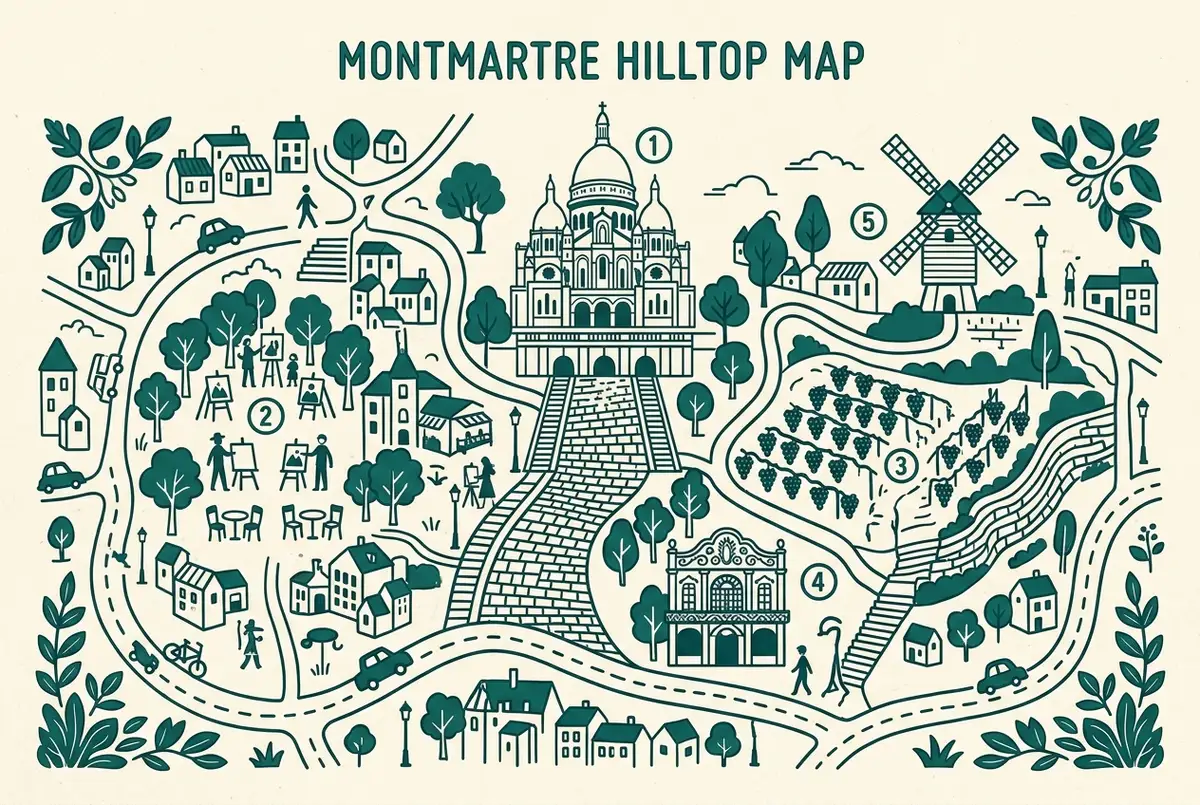
Sacre-Coeur, Place du Tertre, the hilltop vineyard, Lapin Agile and the Moulin Rouge’s exterior make up the core list most visitors should prioritize, each a short walk from the next. I would treat this as a loose route rather than a strict checklist, since the neighborhood rewards unhurried wandering between the named stops as much as the stops themselves.
My honest advice is to pace this across a half day rather than rush it into an hour. Every one of these sights rewards a few minutes of actually standing still in it, not just a photo and a walk-on.
Why Is Sacre-Coeur the Top Attraction?
Sacre-Coeur’s white basilica dome sits at the very top of the Montmartre hill, visible from much of northern Paris, and the view from its steps is one of the better free panoramas in the city. The climb up, whether on foot or via the funicular, is part of the experience rather than an obstacle to it.
I would treat this as the anchor of any Montmartre visit, not one stop among equals. Nearly every other sight on this list sits within a short walk of the basilica, so building your route around Sacre-Coeur as the center point makes practical sense as well as being the obvious highlight.
What Makes Place du Tertre Worth a Stop?
Place du Tertre is the small square just below Sacre-Coeur where working artists set up easels and sell portraits and paintings, a direct, still-functioning link to the neighborhood’s bohemian history. It gets genuinely crowded, especially midday, so expect a lively, busy atmosphere rather than a quiet corner.
My honest take: I would walk through for the atmosphere rather than commit to a formal portrait sitting unless you have real time to spare. The crowds and the sales pitches can be a lot, but the square’s energy is still worth experiencing firsthand rather than skipping entirely.
Is the Montmartre Vineyard Worth Visiting?
Yes, if you know to look for it. Montmartre’s small hilltop vineyard, Clos Montmartre, is an easy-to-miss detail that most visitors walk right past without realizing a working vineyard still sits in the middle of Paris. It is not a large stop, more a few minutes of genuine surprise than a destination in its own right.
I would add this to your route specifically because it reinforces the neighborhood’s village feel better than almost anything else here. It takes only a few extra minutes and rewards visitors who already know it is worth seeking out.
What Is Lapin Agile and Should You Visit It?
Lapin Agile is the small, still-operating chansonnier cabaret that counted Picasso among its regulars in the early 1900s, a genuine surviving piece of Montmartre’s artist history rather than a recreation of one. My Lapin Agile and Montmartre’s cabaret history guide covers the fuller story and whether the show itself is worth booking.
I think this is the attraction most first-time visitors skip entirely, and I would not make that mistake. Place du Tertre gets the crowds for its working artists today, but Lapin Agile is where the neighborhood’s actual bohemian reputation was built, and it costs nothing to view from outside.
Is the Moulin Rouge Itself a Tourist Attraction?
Yes, even for travelers not planning to see the show. The venue’s illuminated red windmill facade at the foot of the hill is one of the most photographed sights in Paris after dark, and plenty of visitors stop for photos without ever buying a ticket. My Moulin Rouge show guide covers what the evening itself actually involves if you decide you want more than a photo stop.
My honest take: even if an evening show is not in your budget or your plans, I would still walk past it after dark at least once. The lit-up windmill at night is worth seeing in person regardless of whether you go inside.
Did the Tour de France Really Ride Through Montmartre?
Yes. Montmartre’s hilltop streets have featured in high-profile cycling routes through central Paris in recent years, a detail that surprises a lot of first-time visitors who assume the hill is purely a pedestrian sightseeing spot. I think this is a genuinely fun piece of trivia to mention if you are into cycling at all, though I would check the official Tour de France site for the current year’s exact route before assuming any specific street is included on a given visit.
How Do You See Montmartre’s Top Attractions in One Day?
Start low near the Moulin Rouge end of the neighborhood in the morning, climb through the quieter residential streets, spend real time at Sacre-Coeur, work across to Place du Tertre and the vineyard, detour briefly to Lapin Agile, then loop back down as the afternoon winds down. My Montmartre walking tour guide lays out this exact route order with timing built in.
I would front-load the steepest climbing while your legs are fresh, and I would not try to rush all five of these into under two hours; the hill’s steep streets slow you down more than the map distance suggests.
What Should You Skip If You’re Short on Time?
If you only have two or three hours rather than a full half day, I would prioritize Sacre-Coeur and Place du Tertre over the vineyard and Lapin Agile, since those two cover the view and the atmosphere most visitors actually come for. The vineyard and Lapin Agile reward travelers with a little more time to spare, since both are small, easy-to-miss details rather than headline sights.
My honest advice: do not try to force all five into a rushed hour just to check every box. I would rather you spend genuine time at two or three stops than a rushed five minutes at each of five, since the atmosphere here comes from lingering, not from covering ground quickly. If you do have the full half day, though, I would still make the effort to catch all five, since the vineyard and Lapin Agile are exactly the kind of detail that makes a return visit feel repetitive if you skip them the first time around.
Is It Better to Visit Montmartre’s Attractions on a Weekday or Weekend?
Weekdays, generally, and by a meaningful margin. Weekend crowds at Sacre-Coeur and Place du Tertre run noticeably heavier than a weekday morning, especially from spring through early autumn when both locals and visitors treat the hill as a day-trip destination.
I would shift a Montmartre day to a weekday if your itinerary gives you any flexibility at all. The sights themselves do not change, but a thinner crowd makes the climb, the viewpoint and the artist square all feel noticeably more worth the trip, which is a real difference even if the underlying attractions are identical either day.
My Honest Recommendation
Sacre-Coeur, Place du Tertre, the vineyard, Lapin Agile and the Moulin Rouge’s exterior together make a genuinely satisfying half-day route, and I would not skip any of the five for the sake of time. My is Montmartre worth visiting guide covers the broader safety and timing questions worth settling before you go, and if your day ends with an evening at the Moulin Rouge itself rather than just a photo of the facade, you can reserve your Moulin Rouge evening in Montmartre here once your daytime route is planned.
Frequently Asked Questions
What is the number one attraction in Montmartre?
Sacre-Coeur, for the view from its steps and its position as the neighborhood’s anchor point. Nearly everything else sits within a short walk of it.
Can you see all of Montmartre’s attractions in one day?
Yes, comfortably in a half day if you pace the route sensibly, starting low on the hill and working your way up toward Sacre-Coeur.
Is Place du Tertre the same as Montmartre?
No. Place du Tertre is one square within the wider Montmartre neighborhood, known specifically for its working artists.
Did the Tour de France actually go through Montmartre?
Montmartre’s hilltop streets have featured in recent high-profile Paris cycling routes. I would check the official Tour de France site for the current year’s specific route.
Is the Moulin Rouge worth seeing even without booking a show?
Yes. The illuminated windmill facade is worth seeing after dark on its own, even if you decide not to book the show itself.