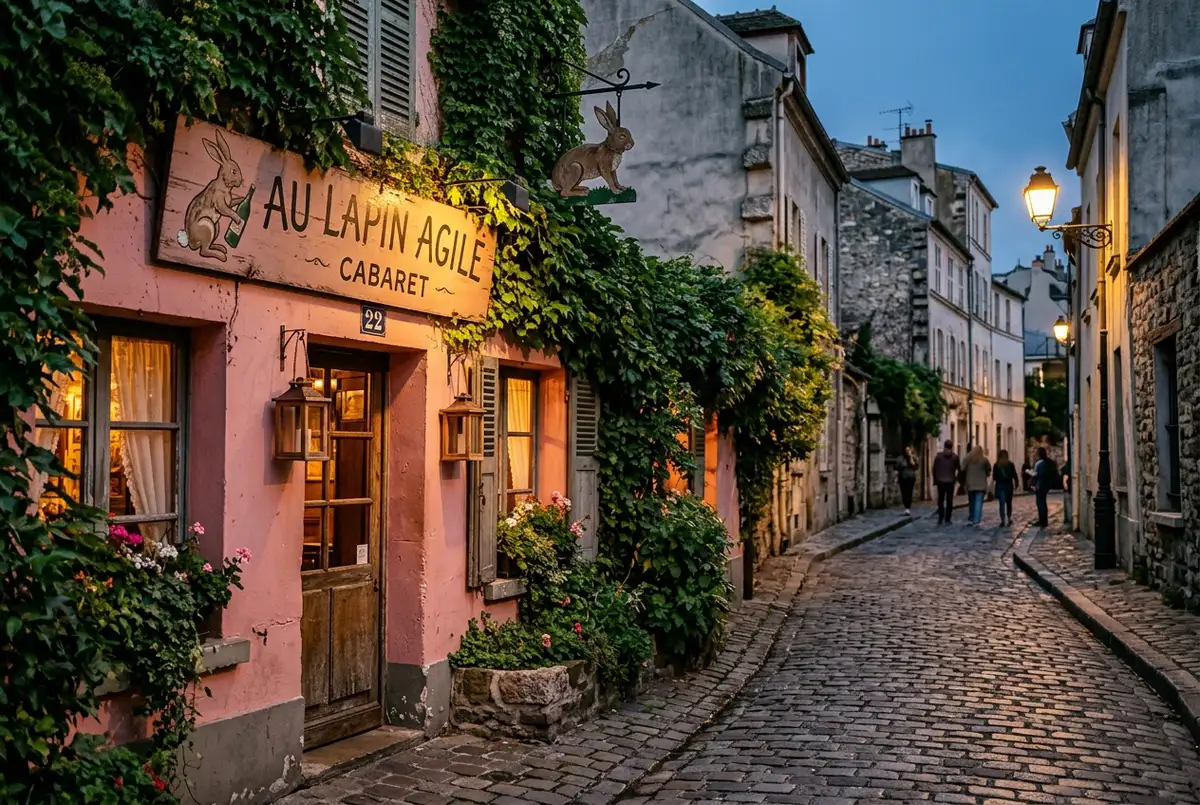
Lapin Agile is the small pink cabaret tucked into a quiet Montmartre side street that counted Picasso, Utrillo and Apollinaire among its regulars in the early 1900s. It is a completely different thing from the revue cabarets most travelers are planning around, and I think it gets overlooked for exactly that reason.
I am going to cover what Lapin Agile actually is, how it differs from a ticketed show like the Moulin Rouge, and whether it is worth building into a Montmartre day. Since the hill’s whole cabaret history ties back to this one small building, it is worth understanding before you decide which of Montmartre’s shows, if any, are worth your evening.
What Is Lapin Agile?
Lapin Agile is a chansonnier, a small venue built around live French song performed close enough to the audience that it feels more like a living room than a stage, rather than a large-production revue. It has operated on the same Montmartre corner since the 19th century and still runs performances today, making it one of the few genuinely surviving pieces of the neighborhood’s bohemian era rather than a recreation of one.
My honest take is that this is the most authentic surviving piece of old Montmartre you can actually walk up to. Most of what gets marketed as “historic Paris” in this neighborhood is really just a backdrop for photos. Lapin Agile is the real thing still doing roughly what it always did.
Why Was Lapin Agile Famous for Picasso and His Circle?
In the early 1900s, Lapin Agile became a regular haunt for a circle of poor, then-unknown artists and writers living in Montmartre, Picasso among them, along with Utrillo, Apollinaire and others who would go on to define early modernism. The venue’s owner at the time reportedly accepted artwork in place of payment from regulars who had no money, which is part of why the building still holds pieces from that era.
I think this story is worth knowing before you walk past the building, since otherwise it just looks like a small pink cafe with a rabbit sign. Picasso himself painted the venue directly, a work now held in a major museum collection, which tells you how seriously this unglamorous little corner of Montmartre mattered to the artists who actually lived there.
How Is Lapin Agile Different From the Moulin Rouge?
Lapin Agile is a small chansonnier built around live song and spoken word in an intimate room, while the Moulin Rouge is a large-scale revue with a full cast, elaborate costumes and a live orchestra. One is closer to a literary cafe with performers; the other is a production on the scale of a theater show. My Moulin Rouge show guide covers what that larger production actually involves if you have not already read it.
I would not expect the same kind of evening from either venue, since they are not really competing for the same visitor. Lapin Agile suits someone genuinely curious about French chanson and the neighborhood’s literary history. The Moulin Rouge suits someone wanting a big, visual, English-friendly production with no language barrier to following along.

Should You Book a Show at Lapin Agile?
Only if French-language chanson and spoken-word performance genuinely interest you, since the shows run in French with little concession made for non-French-speaking visitors. If that is not a dealbreaker for you and you want a genuinely different Paris evening than a big production, it is worth considering.
My honest take: for most first-time Paris visitors, I would treat this as a stop to view from outside rather than a show to book. The language barrier is real, and travelers specifically wanting a cabaret evening they can follow without French tend to get far more out of the Moulin Rouge’s visual, music-driven production instead. My what is a cabaret show guide breaks down the broader genre if you want to understand how chansonnier venues like this one fit alongside revue-style cabarets.
Is Lapin Agile Worth Visiting If You Are Not Booking a Show?
Yes, absolutely, and I think this is the more common and more sensible way most travelers should encounter it. Walking past the building itself, reading a plaque or two, and understanding the history is enough to appreciate what made this corner of Montmartre matter, without needing to sit through a French-language performance.
I would build a few minutes for this stop into any Montmartre walking route rather than skip it entirely. It sits slightly off the main Sacre-Coeur to Place du Tertre path, which is exactly why a lot of self-guided walks miss it without realizing what they passed. My Montmartre walking tour guide covers where this stop fits into a realistic route order.
Where Is Lapin Agile Located?
It sits on a quiet residential corner of Montmartre, a short walk from both Sacre-Coeur and Place du Tertre, tucked away from the busier tourist streets. The Wikipedia entry on Le Lapin Agile has the fuller address and history if you want to read more before you go, and I would check the venue’s own current listing for exact show times before planning a visit around a specific performance.
I think its slightly out-of-the-way location is actually part of the appeal. Finding it feels a little like stumbling onto something most other visitors walk straight past, which fits the neighborhood’s whole bohemian reputation better than a crowded main square would.
What Other Montmartre Attractions Pair Well With This Stop?
Sacre-Coeur, Place du Tertre’s working artist square, and the hilltop vineyard all sit within easy walking distance, and together with Lapin Agile they cover most of what makes Montmartre’s history worth exploring beyond the view alone. My Montmartre tourist attractions guide ranks the fuller list if you want to build a complete half-day route around all of them.
My honest advice: do not treat Lapin Agile as a standalone destination worth a special trip on its own. It earns its place as one stop among several on a broader Montmartre day, not as a reason to come up the hill by itself.
Does Lapin Agile Connect to the Moulin Rouge’s Cabaret Tradition?
Only loosely, and I think that is worth being precise about. Both sit in the same Montmartre entertainment history, and both opened in the same general era of the neighborhood’s rise as a nightlife destination, but they represent two different branches of that history rather than one continuous tradition. The Moulin Rouge grew into a large-scale revue aimed at a broad audience, while Lapin Agile stayed small and literary, closer to its original character than almost anywhere else in the neighborhood.
My honest take is that treating them as two points on the same timeline, rather than rivals or substitutes, is the more accurate way to understand Montmartre’s cabaret history. One shows you where the neighborhood’s nightlife reputation scaled up into a tourist-facing production; the other shows you what it looked like before that happened.
My Honest Recommendation
I would walk past Lapin Agile as part of a broader Montmartre route rather than make a special trip just for it, and I would only book an actual show there if French-language chanson specifically appeals to you. For most first-time visitors, understanding the history from outside the building delivers most of the value without the language barrier. My is Montmartre worth visiting guide covers the broader planning questions worth settling before you build out your day.
If your evening is better spent at a bigger, English-friendly production instead, you can book your Moulin Rouge evening in Montmartre here once you have decided how the rest of your day looks.
Frequently Asked Questions
Is Lapin Agile still open today?
Yes, it still operates as a small cabaret venue, though I would check its current listing for show times before planning a visit around a specific performance.
Why is Lapin Agile famous?
It was a regular hangout for Picasso and his circle of fellow artists and writers in early 1900s Montmartre, making it one of the few genuinely surviving pieces of that bohemian era.
Is Lapin Agile the same as the Moulin Rouge?
No. Lapin Agile is a small, intimate chansonnier built around live French song. The Moulin Rouge is a large-scale revue with a full cast and orchestra.
Do you need to speak French to enjoy a show at Lapin Agile?
It helps a great deal, since performances run in French with little accommodation for non-French speakers. I would view it from outside instead if that is a barrier for you.
Is Lapin Agile worth visiting on a Montmartre walking tour?
Yes, as a brief stop rather than a destination on its own. It sits slightly off the main tourist path, which is part of why it is easy to miss without planning for it.